We develop fully customized, high-performance 3D CPQ configurators for any catalog, even the most complex.
Specialized in the furniture, design and nautical sector, our configurators combine obsessive attention to visual quality with integration with business systems such as e-commerce, CPQ, BOM, ERP and CRM.
Our renderings are crafted to tell the stories of your products made of metals, reflections, lacquers, woods, fabrics, and more through optimal performance on any device
Thousands of variants? No problem. Complex geometries? We love challenges. The result must be fluid, always
We craft animations and lighting not only to depict the products, but make them come alive.
Easy to use. Just what you need, when you need it, coordinated with your brand identity
Explore our demos
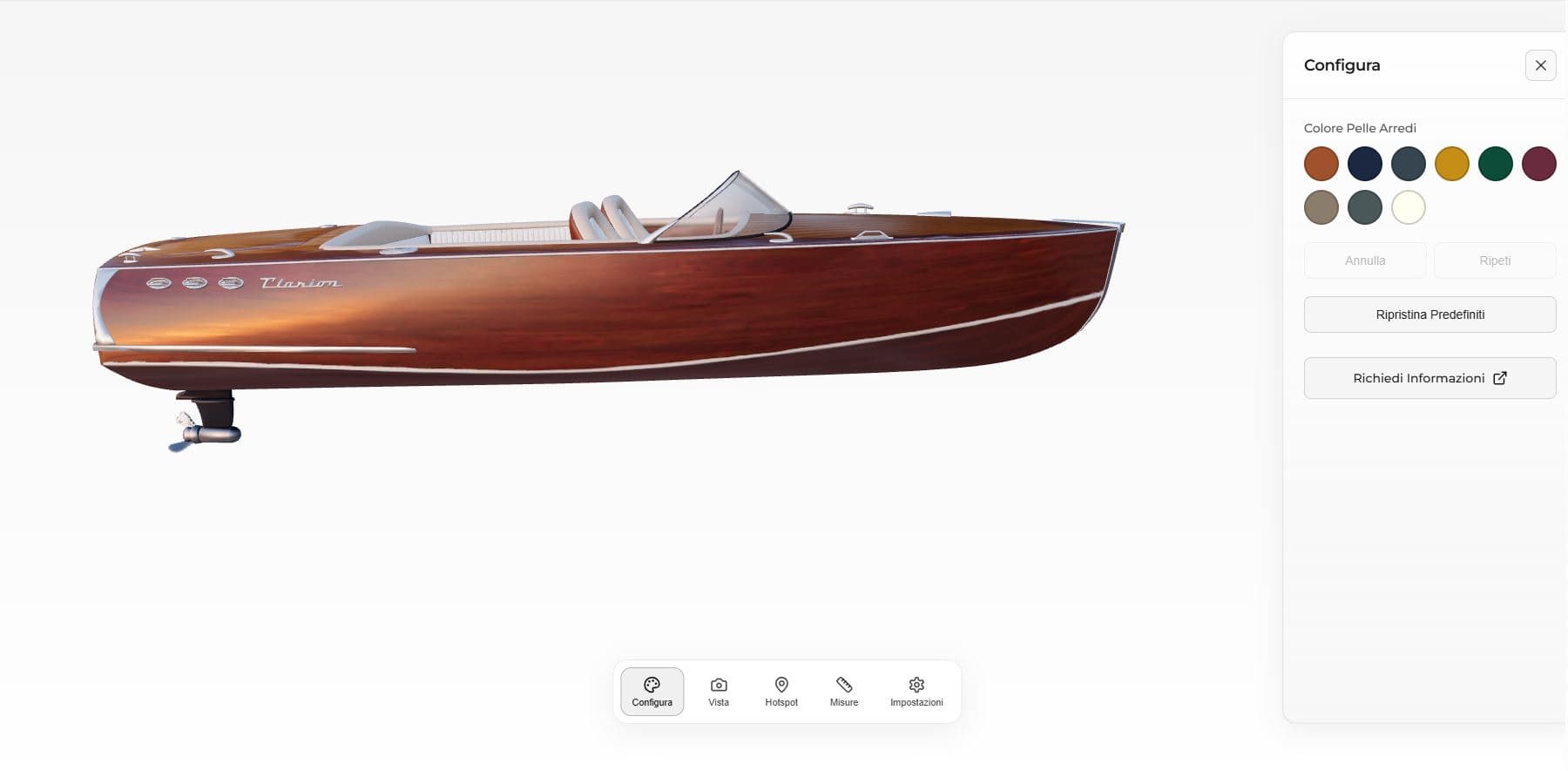 DemoWeb accessible
Nautical 3D Configurator
Photorealistic motorboat configurator with cinematic camera views, interactive hotspots, measurement tools and real-time material customization.
Try the demo3D configurator for modular workshop furniture
B2C 3D configurator integrated into an e-commerce flow to compose workshop furniture, compatible accessories, pricing and checkout.
Read the case study3D room planner for workshops and technical spaces
3D room planner for flooring, furniture and lighting: room drawing, tile layout, collisions, CPQ and integration with the furniture configurator.
Read the case studyCPQ and 3D for roller shutter boxes and shutter systems
Interactive 3D web configurator with guided CPQ flow, rule engine, technical BOM, PDF output and Microsoft Business Central integration.
Read the case study3D configurator and quoting for bathroom furniture
B2B 3D CPQ configurator for bathroom furniture: 8000+ products, parametric rendering, rule engine, PDF quotes and dealer profiles.
Read the case studyWhen to choose Parametra?
In the following cases we are confident that our configurators are the ideal choice
When your catalog is complex
We develop custom logic that dynamically manages all catalog variants. Thanks to the dynamic filtering system, every customer choice is processed in real-time, updating the automated quotation and showing only the combinations of products, colors, materials, finishes, and customizations that are actually available.
When you create product compositions
Our configurators not only handle individual products but also the relationships between products and their spatial relationships. This best meets the needs of segments like kitchens, bathroom furniture, and wardrobes.
When you also create custom products
We can create your products with parametric rendering, making it possible to render products with non-standard measurements, down to the millimeter.
When you seek a solution that doesn't disrupt your way of working
Creating custom configurators allows us to perfectly adapt to your business dynamics, either by integrating with your existing systems or functioning as a standalone solution.
Development Cost
Every 3D configurator developed by Parametra is custom-made, and so is the quote.
Most of our complete 3D CPQ configurator projects, including integrations necessary for business logic, fall within the €12,000–35,000 range, while particularly complex cases may exceed it.
Project Factors
The development cost depends on a combination of project factors, including:
- number of products
- number of variants per product
- number of products configured simultaneously and complexity of compatibility rules
- quantity of 3D models to optimize or create from scratch
- texture creation method (standard libraries or real scans)
- level of user experience customization (animations, micro-interactions, guided flows)
- integrations with the company's digital ecosystem (ERP, CRM, e-commerce, etc.)
- integrations with external data sources (e.g., real-time exchange rates for multi-currency)
- complexity of the required management system (user roles, internal database, dashboard, analytics)
A 3D configurator can, in particular cases, present high complexity across all these aspects. However, this is a rather rare situation, especially for the typical needs of SMEs.
The much higher cost estimates found in some international analyses often derive from the assumption that all these complexities are present simultaneously, an approach that rarely reflects the real needs of projects.
Lower end of the range
The lower end of the range represents a professional configurator where you can modify the variants of a single product per page and a limited number of products. It includes polished animations (e.g., camera movements or material transitions), designed micro-interactions, standard integration with business systems (ERP, CRM, e-commerce) and optimization of existing 3D models for the web.
Typical examples are configurators for seating or fashion products customizable through materials, colors and finishes.
Upper end of the range
The upper end of the range includes configurators with some of the following features: compatibility logic between products and variants, positioning in space, management of non-standard measurements through parametric rendering, or complex multi-step user experiences.
Typical examples are configurators for bathroom furniture, kitchens and some nautical applications.
An example of an intermediate case could be a configurator for modular sofas or for flooring and boiserie systems.
In any case, configurators for single products can also increase in price in the presence of particularly complex animations or integrations, advanced administrative dashboards, or the need to create numerous complex 3D assets from scratch.
Performance and Usage
Configurators developed by PARAMETRA aim to offer a user experience with optimal loading times and availability across different contexts and devices:
| Load time | Under 2 seconds on 4G mobile, through 3D model optimization and asynchronous progressive loading logic |
|---|---|
| Supported devices | Desktop, tablet, mobile |
| Offline use | Available for offline use via PWA (useful for resellers at trade fairs or in showrooms) |
Supported Integrations
Custom configurators developed by Parametra can integrate with any management system with exposed and documented APIs, particularly:
E-commerce: Shopify · WooCommerce · Magento · PrestaShop · custom
CRM: HubSpot · Salesforce · Zoho · TeamSystem · Pipedrive · custom
ERP: SAP · Odoo · Zucchetti · proprietary management systems via API
The configurator can produce the correct output for the existing business process, such as PDF quote, CRM lead-capture, production BOM, management system export, e-commerce cart
The configurator can be integrated, at the Client's discretion, into the company website via iframe (maximum visual integration) or be accessible on a dedicated subdomain (easier integration and maximum performance).
What We Need From You
Below are the elements that allow Parametra to develop the configurator suited to your company's needs. For each of these points, our service includes guidance to formalize knowledge and make the necessary decisions.
| 3D Models | glTF/GLB ideal · STEP/OBJ/FBX with conversion · or we create them |
|---|---|
| Configuration rules | Compatibility, constraints ("what goes with what") if present |
| Price list | Prices + logic (surcharges, discounts), also in Excel format |
| Contact person | Who knows the products + who manages price lists + who will test |
| Test criteria | Sample products, scenarios, metrics for "ready" |
Guarantees and Regulations
| Post-launch changes | Period included in the price |
|---|---|
| Staging environment | Always active for safe testing |
| Support response | Within 24h |
The configurators created comply with relevant European regulations, particularly GDPR and EAA where applicable.
Timing and Work Process
The time required depends on the complexity of the project: on average, a configurator takes between 5 to 15 weeks to complete.
We can provide you with a preliminary analysis of the timing and a cost range during a free introductory call Then we generally follow these steps.
Preliminary Analysis
We analyze your needs together, study your catalog, and identify available assets and the ones to be created
Detailed Quote
We provide a complete quote that includes timeline, costs, training and testing procedures
Design & UX
The goal of this phase is to have full confidence that the final user experience will exactly be what your business needs
Development
Once design and UX are approved, we develop the parametric logic, 3D assets and custom integrations
Review & Testing
Time for refinement. After our internal testing, you have full access to the configurator to test it thoroughly and we execute all other agreed testing procedures
Release
The configurator is live on your domain, we share support documentation, and provide training for your team
Managed hosting
Our managed hosting service is based on SOC 2 Type 2 and ISO 27001:2022 certified providers, with data hosted within European Union for GDPR compliance. The infrastructure ensures optimal performance through a global CDN, 99.5% availability, and automatic backups with recovery features.
The configurator is published on a custom domain of your choice, then we take care of all technical aspects, maintenance, updates, and security, to have it operate seamlessly.